The World's 8 Most Deceptive Foods: We Think They're Healthy, but Should Think Again
by www.SixWise.com
You can turn on just about any news program and hear about the declining health and increasing waistlines of Americans. The news is getting to us, as attested by the changes many people are finally making to their diets.
Just ask Whole Foods Market, one of the more widely known health food chains. Their annual revenue has increased by more than 50% over the past four years.
|

Deciphering what's healthy can feel like a full-time job.
|
Overall sales of natural and organic foods increased 7 percent per year -- making it the fastest-growing sector of the grocery industry, according to Cooperative Grocer magazine.
But just when you thought it was safe to go into your favorite health food store and grab everything "healthy" off the shelves, we hit you with this: some "health" foods are remarkably deceptive, and while we think eating them will do our bodies good, we have been seriously led astray.
Here are the eight that have fooled many an otherwise sensible and informed soul:
1. Muffins
Next to a danish or a doughnut, the muffin looks like a sensible choice. It's got fruit, after all, and maybe even a little bran. A muffin is a light, nutritious breakfast food -- or so we've been hearing since the 1980s.
When you actually break down a muffin, though -- sugar, flour, butter/margarine, etc. -- you realize that if it came in a slightly different shape with some frosting, it wouldn't be called a muffin ... it would be called "cake."
And then there's the size. A small plum-sized muffin that your grandmother baked is one thing. The giant concoctions in most bakeries, grocery stores and coffee shops today are another. These muffins contain anywhere from 340 to 630 calories and 11 to 27 grams of fat, plus lots of sugar and other additives. They may also contain trans fats--those nasty fats that raise your bad LDL cholesterol and lower the good (HDL) kind.
Healthy Alternative: If you must have a muffin, bake your own using real ingredients, keep them small, and eat it as a special desert -- not a breakfast.
2. Fast-Food Salads
Yes, you went to that fast-food joint near your office for lunch, but all was not lost -- you ordered a salad! Most fast-food chains have jumped on the health bandwagon and are now offering salads, wraps and other "healthy" menu choices for just such nutrition-minded customers.
And while some won't come right out and say they're healthy (McDonald's, for instance, no longer uses the word because ""our consumer research shows people don't understand it and it's actually a turn off when it comes to food items."), it is certainly implied in their ads featuring fit, active people and catchy nutrition slogans.
But all salad is not inherently healthy.
"You hear the word 'salad,' you think vegetable, you think good choice--what you have to look at is what's on the salad," said Lisa Cimperman, a nutritionist at University Hospitals in Cleveland.
In fact, most of the salad ingredients that most fast food chains use make most of them "no more healthful than a burger without the bun, dipped in salad dressing," said the Physicians Committee for Responsible Medicine (PCRM), which conducted a nutrition analysis of 34 fast food salads.
One of their more startling findings: McDonald's Crispy Bacon Ranch Salad has more fat and calories and just as much cholesterol as a Big Mac.
Culprits that make good salads go bad are fried meats, additions like croutons and crispy noodles, bacon, and high-fat salad dressings. Many even have added sugar.
"We did not expect these new salad entrées to be so loaded with fat and cholesterol," says Brie Turner-McGrievy, M.S., R.D., the clinical research coordinator at PCRM.
Healthy Alternative: Create your own fresh salad using lots of veggies, some lean protein (egg, chicken), a few nuts or seeds or a small amount of cheese, and a little olive oil and balsamic vinegar dressing.
|

Eating this giant bagel is like eating four or five slices of bread.
|
3. Processed Soy Products
While fermented and unprocessed soy products (like edamame, tempeh and miso) can be quite nutritious, processed soy products fall short.
Despite the myriad of health claims that surround them (and tout them as near miracle foods), processed soy foods like soymilk, soy meat products, soy ice cream, soy energy bars, etc., have been linked to:
- Malnutrition
- Digestive problems
- Thyroid dysfunction
- Cognitive decline
- Reproductive disorders
- Immune system breakdowns
- Heart disease
- Cancer
Says Dr. Kaayla Daniel, author of The Whole Soy Story:
"Unlike in Asia where people eat small amounts of whole soybean products, western food processors separate the soybean into two golden commodities--protein and oil. There's nothing safe or natural about this. Today's high-tech processing methods not only fail to remove the antinutrients and toxins that are naturally present in soybeans but leave toxic and carcinogenic residues created by the high temperatures, high pressure, alkali and acid baths and petroleum solvents."
Healthy Alternative: If you want to eat soy, stick to the unprocessed versions (edamame, tempeh, miso) and read labels to avoid the rest.
4. Bagels
Most people eat one or two pieces of toast at a time -- four or five would just be excessive, right? Well, many of us eat that and more when we pick up a giant bagel on the way to work.
"A bagel at some of the bagel chains can be four servings of bread. But people have no idea that bagels can be that dense," says Mary Story, a nutritionist at the University of Minnesota in Minneapolis.
And as we hear so often these days, all that processed white flour, those simple carbs, aren't good for us. Combine that with the fact that bagels offer little else in terms of nutrition, and you're left eating a hefty does of carbs that will convert quickly to sugar once in your body.
IF you could find a bagel that was made from whole grains, it would make a slightly better choice, as the added fiber would help slow down the breakdown from starch to sugar. However, whole-grain bagels are a rarity.
Says A.N. Spreen, M.D., "It is nearly impossible to find 100 percent whole-grain (of any type) flour in bagels. Even 'whole wheat' bagels are mostly white flour with a little whole wheat thrown in ... I'm afraid the health concept of bagels has been a bit perverted by the flour industry ... the shelf life (not your life) is the primary concern, and fresh, whole-grain flour is poor in that respect."
Healthy Alternative: Skip the bagel and have 1 serving of whole-grain toast instead. If you must have a giant bagel, split it with a friend.
5. Energy Drinks
Their labels say they contain various herbs, minerals and the amino acid taurine, specially designed to boost your energy by the time you reach the bottom of the can. But if you look at the ingredients, you'll find that the main ingredients in most energy drinks are actually caffeine and sugar -- making them hardly more than high-priced soft drinks.
Yet their glitzy designs and claims to improve your performance, concentration and reaction speeds seem to be working. In 2004, energy drinks overtook bottled water as the fastest-growing category in the beverage business. Similar products have even been introduced for kids as young as 4 years old.
"This is shameful marketing," said Madelyn H. Fernstrom, associate professor and director of the University of Pittsburgh Medical Center Weight Management Center, of KickStart Spark, one such product specifically marketed for children 4 years and older.
"Under the guise of 'good health,' this is a promotion of caffeine consumption, which will likely have a biological effect on most children who consume it, since their intake is low ... There's nothing that's redeeming in any of this stuff. At the very least it's a huge waste of money," she said.
Healthy Alternative: Drink healthier fluids like water or tea, and if you must have a jolt of energy, a good old-fashioned cup of black coffee will at least spare you the sugar.
|
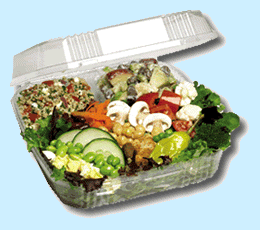
Just because it has lettuce, doesn't mean it's healthy. Some fast food salads are worse than the burgers.
|
6. Diet Soda
You know regular soda is bad because of all that sugar and "empty" calories, but what's wrong with a diet soft drink to quench your thirst?
Plenty, according to experts. Along with caffeine, like regular soda, diet soda is high in phosphoric acid, a combination that could be bad for your bones. While caffeine can interfere with your body's ability to absorb calcium or increase the amount it gets rid of, the acids in soda can cause the body to become more acidic -- causing it to release even more calcium.
"Too many soft drinks may result in excessive phosphorus in the diet, and that can result in low blood calcium levels. The body will respond by pulling calcium from the bone to increase the amount of calcium in the blood," says Lisa Ritchie, director of the Didactic Program in Dietetics at Harding University in Arkansas.
Then there's the problem with the artificial sweeteners, which some say are harmful. Although Splenda is a newcomer to the diet soft drink sweetener market - and there are growing concerns as to its actual safety -- aspartame is still the most widely used sweetener in diet soda.
"Aspartame is the most complained about additive in U.S. history," says Dr. Joseph Braco, author of "Restoring Your Digestive Health." "It's been blamed for everything from headaches to rashes to seizure disorders. I have a physician friend who clearly linked aspartame with his adult-onset seizures."
Healthy Alternative: Choose water or unsweetened tea instead, and if you do drink diet soda, limit your intake to an occasional "treat."
7. Fish
Fish would be a healthy form of protein if not for the high levels of pollutants that contaminate many varieties. Although the American Heart Association recommends eating fish at least twice a week, they note that some types of fish may contain high levels of mercury, PCBs (polychlorinated biphenyls), dioxins and other environmental contaminants.
This is particularly important for women who may become pregnant, pregnant women, nursing mothers and young children, as developing and unborn children are susceptible to nervous system damage from mercury. You can read the Environmental Protection Agency's fish consumption guidelines for this at-risk group for specific information.
|
High-Mercury Fish
- Shark
- Swordfish
- King Mackerel
- Tilefish
- Grouper
- Marlin
- Orange Roughy
|
Lower-Mercury Fish
- Anchovies
- Calamari (squid)
- Pollock
- Catfish
- Whitefish
- Perch (ocean)
- Scallops
- Flounder
- Haddock
- Hake
- Herring
- Shad
- Sole
- Salmon
- Tilapia
- Sardines
- Trout (freshwater)
|
Healthy Alternative: Pregnant women, those who may become pregnant, nursing mothers and children should consult the EPA guidelines above for safe fish consumption. Everyone else may want to stick to lower mercury varieties, and seek out wild-caught sources, which tend to be lower in pollutants than farm-raised varieties.
8. Protein/Energy Bars
So energy drinks aren't the best option ... what about energy bars?
Says Lynn Grieger, a registered dietitian and certified diabetes educator, "Since consumers are driven by taste and cost, the current trend is for bars that taste great, but pack less nutritional value. While some bars are low in total fat and saturated fat, others can have as much fat and saturated fat as a Snickers bar."
If you're choosing between an order of French fries or an energy bar, you're probably better off with the energy bar. But the general consensus among experts is that you're almost always better off eating real food than a fortified, processed bar.
Or, as Rebecca Wood, an educational consultant to organizations in the natural food industry, puts it, "An energy or power bar is a candy bar. Or, at best, a next-generation candy bar gussied up with protein powder. A candy bar is sugar with fat plus added flavor from chocolate, nuts, seeds, fruit or the like. Add 2-cents worth of protein powder to a candy bar and subtract any guilt because it's now "healthy."
"Sure, some [energy bars] have added protein, vitamins and minerals or even antioxidants, but we can get all of those healthy nutrients from foods for considerably less money," says Grieger.
Healthy Alternative: Stock up on easy-to-carry high-energy and natural foods like nuts, seeds, cheese and dried fruit, and avoid the temptation of splurging on an energy bar in the throes of an unplanned hunger attack.
Recommended Reading
High Fructose Corn Syrup: Why the World's Most Popular Sweetener is Enemy #1 to Your Health and Waistline
The 11 Healthiest Autumn Fruits and Vegetables
Sources
Star-Telegram
ABC News
Medicine Net: Fast Food Salads High in Fat
Diet-blog
Detroit Free Press
National Resources Defense Council
Energy Bars: Health Food or Candy?
Be Nourished